

Gravity Die Castings
Gravity cast aluminium parts with lower porosity, for pressure-tight and machined-heavy work.
Gravity casting fills slower, so it entraps less gas and the part machines clean. It is the right answer when the casting is pressure-tight or more than half of it gets milled away.
6–9 weeks
50 pieces
ISO 9001:2015
Technical Specifications
| Parameter | Value | Unit |
|---|---|---|
| Casting tolerance | ISO 8062 DCTG 6–8 | - |
| Min wall | 3.0 | mm |
| Porosity | Lower than HPDC | - |
| Max part weight | 30 | kg |
| Mould life | 30,000–80,000 | shots |
| Machined face | ±0.05 | mm |
Available Materials
- LM6 (AlSi12)
- LM25 (AlSi7Mg)
- A356-T6
Typical Applications
- Pressure-tight pump bodies
- Manifolds
- Valve bodies
- Heat exchanger housings
- Heavy machined brackets
Surface Finishes
- As-cast
- Heat treated (T6)
- Shot blast
- Machined faces
- Anodise
- Impregnation
Industries Served
- Hydraulics & Pneumatics
- Energy & Oil & Gas
- Marine
- Industrial Equipment
- Food Processing
What drives the price of this part
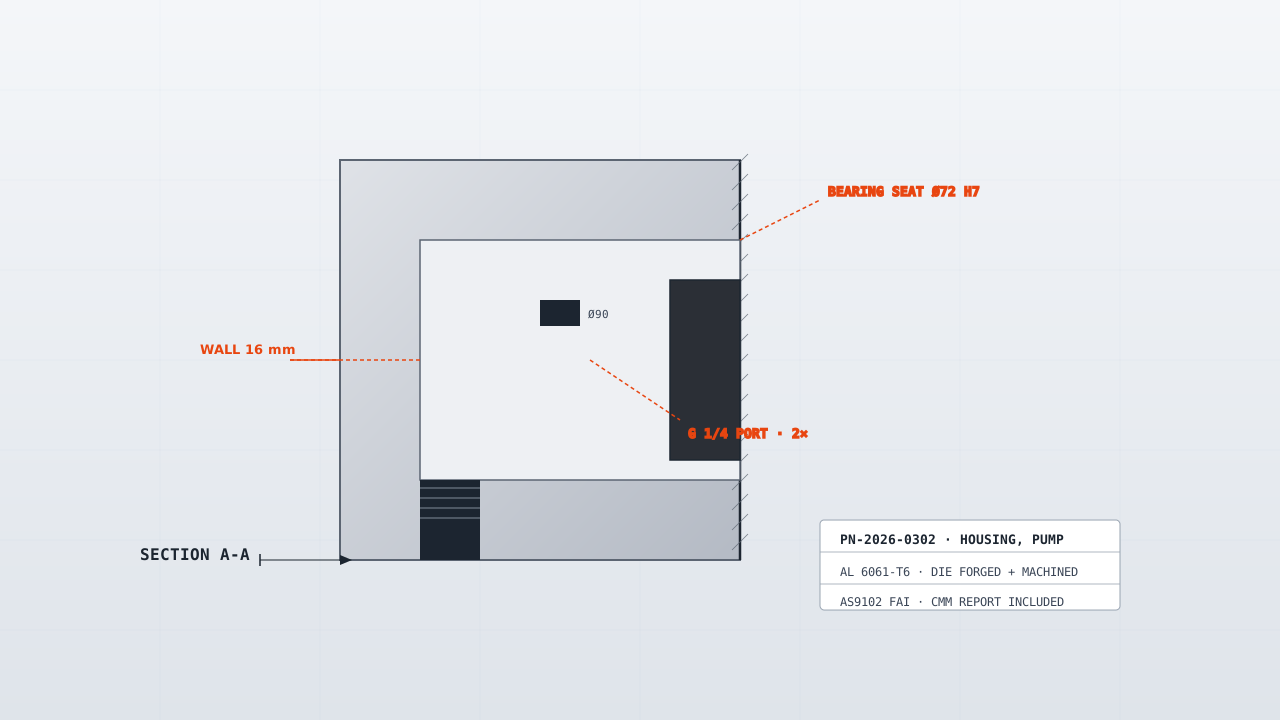
Derived from the callouts on this page. Where a driver is not on the drawing, it is not on this list.
- Tolerance
- Casting tolerance at ISO 8062 DCTG 6–8 is the tightest callout this family carries. Tightening a callout is a process decision, not a machining decision: below the standard ±0.005 mm the work moves to grinding or jig boring, and the price moves with it.
- Part size
- Min wall at 3.0 mm decides which machine the part lands on and how many setups it needs. Size is the driver buyers most often leave out of a first enquiry, and it is the one that changes the quote fastest.
- Order size
- Minimum order is 50 pieces, where setup and tooling are amortised across the batch and per-part cost settles around cycle time and material. Below that quantity the same part costs more per piece, not less.
See how cycle time is calculated in the machining time calculator and what else moves a price in the cost driver reference.
How these parts are inspected
Matched to the callouts above and the instruments actually on the floor.
- Coordinate measuring machine (Zeiss CONTURA G2, two machines, GR&R 8.4% on the critical feature)
- Dimensional report against the drawing, with a 100% check on critical features rather than a sample
- Certificate of conformance and the mill certificate with every shipment
The full equipment list, with counts, is on the capability page; the inspection sequence is on quality and inspection.
Questions buyers ask
- Gravity or high-pressure for a pressure-tight part?
- Gravity, almost always. HPDC traps gas in the wall and the part weeps under pressure; gravity fills slow enough that the gas escapes, at the cost of a slower cycle.
- Why is gravity casting cheaper for low volume?
- The mould is a machined steel die either way, but the gravity tool sees lower pressure and lasts longer between repairs. Below a few thousand parts a year the tooling economics favour it.
Related part families
Aluminium Die Cast Housings
High-pressure aluminium housings from 0.5–15 kg, trimmed, machined and sealed-face checked in-house.
Hydraulic Manifolds
Machined manifolds with cross-drilled galleries, pressure tested to 350 bar before shipping.
Die Cast Tooling & Inserts
H13 mould inserts, cores and slides, EDM-finished and nitrided for production die casting.