

Magnesium Die Cast Parts
Magnesium castings 30% lighter than aluminium, for housings where weight is the constraint.
Magnesium when the part has to be light and stiff. It casts thinner walls than aluminium and machines faster, but it needs its own handling - chips burn, so coolant and housekeeping are not optional.
6–8 weeks
250 pieces
ISO 9001:2015 · IATF 16949
Technical Specifications
| Parameter | Value | Unit |
|---|---|---|
| Wall thickness from | 1.2 | mm |
| Density | 1.81 | g/cm³ |
| Casting tolerance | DIN 1686 t5–t6 | - |
| Max part weight | 8 | kg |
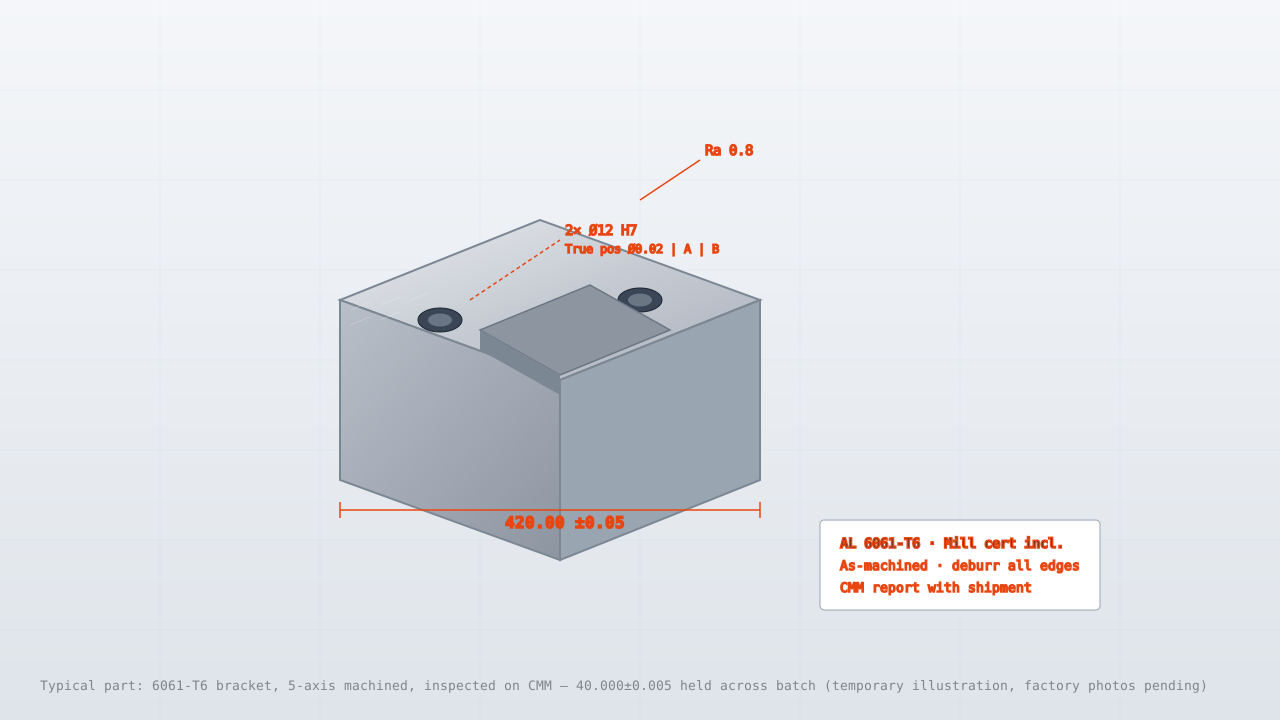
| Machined face | ±0.05 | mm |
| Corrosion protection | Chromate + coat | - |
Typical Applications
- Drone and UAV frames
- Automotive instrument carriers
- Laptop and camera chassis
- Portable equipment housings
- Powersport components
Surface Finishes
- Chromate conversion (mandatory)
- Powder coat
- E-coat
- Paint
- Machined faces
Industries Served
- Automotive & EV
- Aerospace
- Consumer Electronics
- Robotics
- Defence
What drives the price of this part
Derived from the callouts on this page. Where a driver is not on the drawing, it is not on this list.
- Tolerance
- Casting tolerance at DIN 1686 t5–t6 is the tightest callout this family carries. Tightening a callout is a process decision, not a machining decision: below the standard ±0.005 mm the work moves to grinding or jig boring, and the price moves with it.
- Part size
- Wall thickness from at 1.2 mm decides which machine the part lands on and how many setups it needs. Size is the driver buyers most often leave out of a first enquiry, and it is the one that changes the quote fastest.
- Material
- The first material listed, Magnesium Alloy AZ91D (die casting), rates 8/10 on our machinability scale at 65–75 HB. On this shop's scale a harder alloy means slower passes and more tool changes, and that is cycle time the quote has to carry.
- Order size
- Minimum order is 250 pieces, where setup and tooling are amortised across the batch and per-part cost settles around cycle time and material. Below that quantity the same part costs more per piece, not less.
See how cycle time is calculated in the machining time calculator and what else moves a price in the cost driver reference.
How these parts are inspected
Matched to the callouts above and the instruments actually on the floor.
- Coordinate measuring machine (Zeiss CONTURA G2, two machines, GR&R 8.4% on the critical feature)
- Dimensional report against the drawing, with a 100% check on critical features rather than a sample
- Certificate of conformance and the mill certificate with every shipment
- First article inspection to AS9102, because this family carries an aerospace or automotive certificate
The full equipment list, with counts, is on the capability page; the inspection sequence is on quality and inspection.
Questions buyers ask
- Is magnesium safe to machine?
- With the right coolant and no dry chips accumulating, yes. Fine magnesium dust is the hazard, so we keep the swarf wet and cleared - that is a housekeeping discipline, not a machining problem.
- Why not just use aluminium?
- Weight, when it is the driving constraint. Magnesium is about a third lighter with similar stiffness, which is why thin-walled housings that get carried or flown use it.
Related part families
Aluminium Die Cast Housings
High-pressure aluminium housings from 0.5–15 kg, trimmed, machined and sealed-face checked in-house.
Zinc Die Cast Components
Zamak 3 and 5 hardware cast to 0.05 mm, ideal for small parts that need sharp detail and instant plating.
Gravity Die Castings
Gravity cast aluminium parts with lower porosity, for pressure-tight and machined-heavy work.