

CNC Machined Housings
Machined housings with bored seats and sealing faces, held coaxial to 0.01 mm.
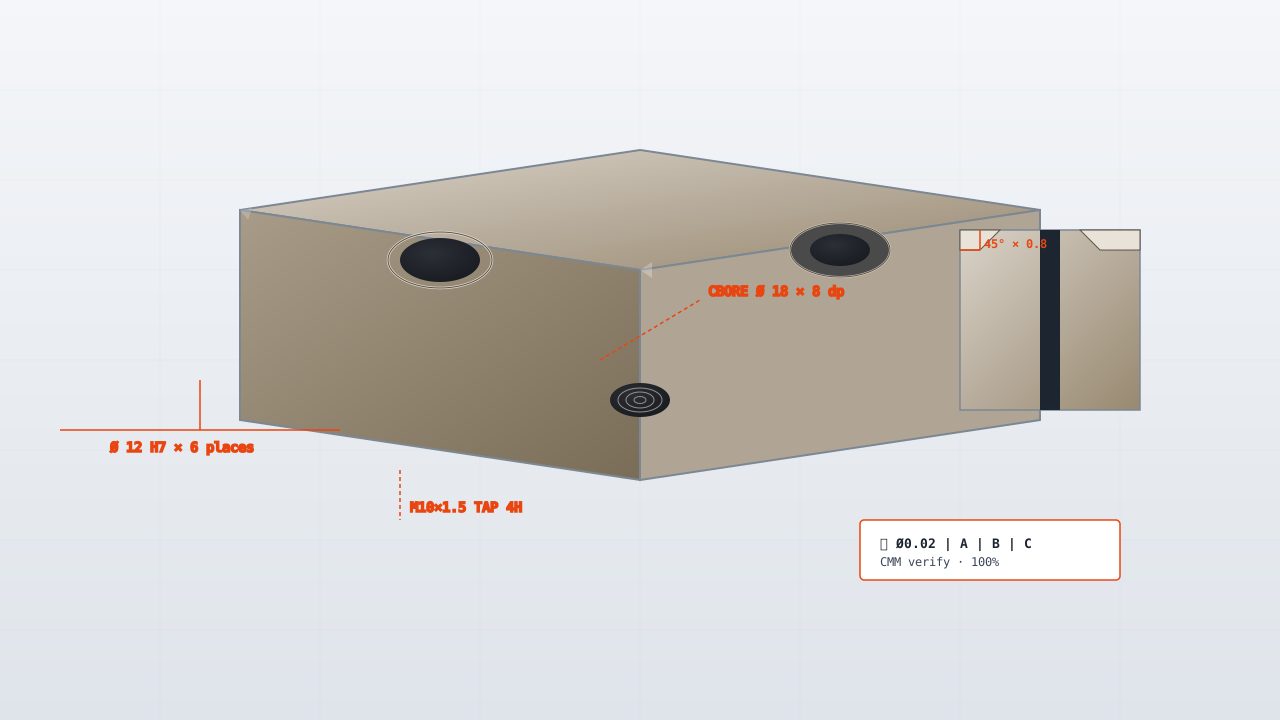
Housings from billet where the casting volume does not justify a tool. Bores are cut in one setup so the seats stay coaxial, and sealing faces are milled flat to hold a gasket.
How we make it: Precision CNC machining service →
H7 -0.01 mm0.02 mm1000 × 800 × 600 mm
Lead Time
3–5 weeks
Min Order
1 piece
Certifications
ISO 9001:2015
Technical Specifications
| Parameter | Value | Unit |
|---|---|---|
| Bore tolerance | H7 | - |
| Coaxiality | 0.01 | mm |
| Sealing face flatness | 0.02 | mm |
| Max envelope | 1000 × 800 × 600 | mm |
| Wall down to | 1.5 | mm |
| Surface roughness | Ra 1.6 | µm |
Available Materials
- Aluminium 6082-T6
- Stainless 316L
- Steel 1045
- Cast iron GGG40
- Aluminium 7075-T651
Typical Applications
- Gearbox housings
- Pump and motor bodies
- Sensor enclosures
- Bearing carriers
- Valve bodies
Surface Finishes
- Anodise
- Painted
- Painted inside + out
- Passivate
- Machined sealing faces
Industries Served
- Industrial Equipment
- Energy & Oil & Gas
- Automotive & EV
- Marine
- Automation
What drives the price of this part
Derived from the callouts on this page. Where a driver is not on the drawing, it is not on this list.
- Tolerance
- Bore tolerance at H7 is the tightest callout this family carries. Tightening a callout is a process decision, not a machining decision: below the standard ±0.005 mm the work moves to grinding or jig boring, and the price moves with it.
- Part size
- Wall down to at 1.5 mm decides which machine the part lands on and how many setups it needs. Size is the driver buyers most often leave out of a first enquiry, and it is the one that changes the quote fastest.
- Surface finish
- Surface roughness at Ra 1.6 µm. Every step below the ordinary as-machined Ra 1.6 µm adds a finishing pass; a callout on a face nobody touches is the most common over-specification we quote.
- Material
- The first material listed, Aluminium 6082-T6, rates 9/10 on our machinability scale at 95 HB. On this shop's scale a harder alloy means slower passes and more tool changes, and that is cycle time the quote has to carry.
- Order size
- Minimum order is 1 piece, so on a first order setup and programming are spread over very few parts and they are most of the price. Repeat orders at the same quantity are cheaper without anything on the drawing changing.
See how cycle time is calculated in the machining time calculator and what else moves a price in the cost driver reference.
How these parts are inspected
Matched to the callouts above and the instruments actually on the floor.
- Coordinate measuring machine (Zeiss CONTURA G2, two machines, GR&R 8.4% on the critical feature)
- Dimensional report against the drawing, with a 100% check on critical features rather than a sample
- Certificate of conformance and the mill certificate with every shipment
- Surface roughness tester (Mitutoyo) against the Ra callout
- Bore gauges and an optical comparator for hole position and edge form
The full equipment list, with counts, is on the capability page; the inspection sequence is on quality and inspection.
Questions buyers ask
- Machined from billet or cast?
- Billet below roughly 20 units a year, cast above it. Billet removes the tooling cost and the porosity risk; casting wins once the volume spreads the die over enough parts.
Related part families
More in CNC Machined Parts
Precision Milling ComponentsCNC Turned ShaftsEDM Cut ComponentsPrecision Turned Components5-Axis Machined ComponentsCustom CNC MachiningPrototype CNC PartsSwiss-Turned PartsAluminium CNC PartsStainless Steel Machined PartsTitanium Machined ComponentsCNC Machined FlangesInconel & Superalloy Machined PartsBrass Machined ComponentsEngineering Plastic Machined PartsCNC Machined BushingsCNC Machined BracketsCNC Machined CouplingsMill-Turn ComponentsCNC Machined Plates & BasesCNC Machined ImpellersCNC Machined End CapsCNC Machined Adapter PlatesHardened & Ground Machined Parts