

Sintered Bronze Bushings
Oil-impregnated bronze bushings with controlled porosity, for places you cannot re-lubricate.
Sintered bronze bushings pressed to your bore and length, with the porosity controlled so the oil stays in the wall. No re-greasing point, which is why they end up in sealed gearboxes and small motors.
3–5 weeks
500 pieces
ISO 9001:2015
Technical Specifications
| Parameter | Value | Unit |
|---|---|---|
| Density | 6.4–6.8 | g/cm³ |
| Bore tolerance (sized) | ±0.01 | mm |
| Bore range | 2–100 | mm |
| Wall thickness | 1–15 | mm |
| PV limit (dry) | 1.8 | MPa·m/s |
| Operating temperature | −30 to 120 | °C |
Available Materials
- Bronze CuSn6 (SAE 841)
- Bronze CuSn8 (SAE 863)
- Iron-copper blends
- Bronze + PTFE (dry running)
Typical Applications
- Small motor bearings
- Fan and blower shafts
- Office equipment
- Sealed gearbox pinions
- Door hinge and damper pivots
Surface Finishes
- Oil impregnated
- Machined OD (secondary)
- Sizing ID
- PTFE filled
- As-sintered
Industries Served
- Industrial Equipment
- Automotive & EV
- Instrumentation
- Food Processing
- Appliance Manufacturing
What drives the price of this part
Derived from the callouts on this page. Where a driver is not on the drawing, it is not on this list.
- Tolerance
- Bore tolerance (sized) at ±0.01 mm is the tightest callout this family carries. Tightening a callout is a process decision, not a machining decision: below the standard ±0.005 mm the work moves to grinding or jig boring, and the price moves with it.
- Part size
- Bore range at 2–100 mm decides which machine the part lands on and how many setups it needs. Size is the driver buyers most often leave out of a first enquiry, and it is the one that changes the quote fastest.
- Order size
- Minimum order is 500 pieces, where setup and tooling are amortised across the batch and per-part cost settles around cycle time and material. Below that quantity the same part costs more per piece, not less.
See how cycle time is calculated in the machining time calculator and what else moves a price in the cost driver reference.
How these parts are inspected
Matched to the callouts above and the instruments actually on the floor.
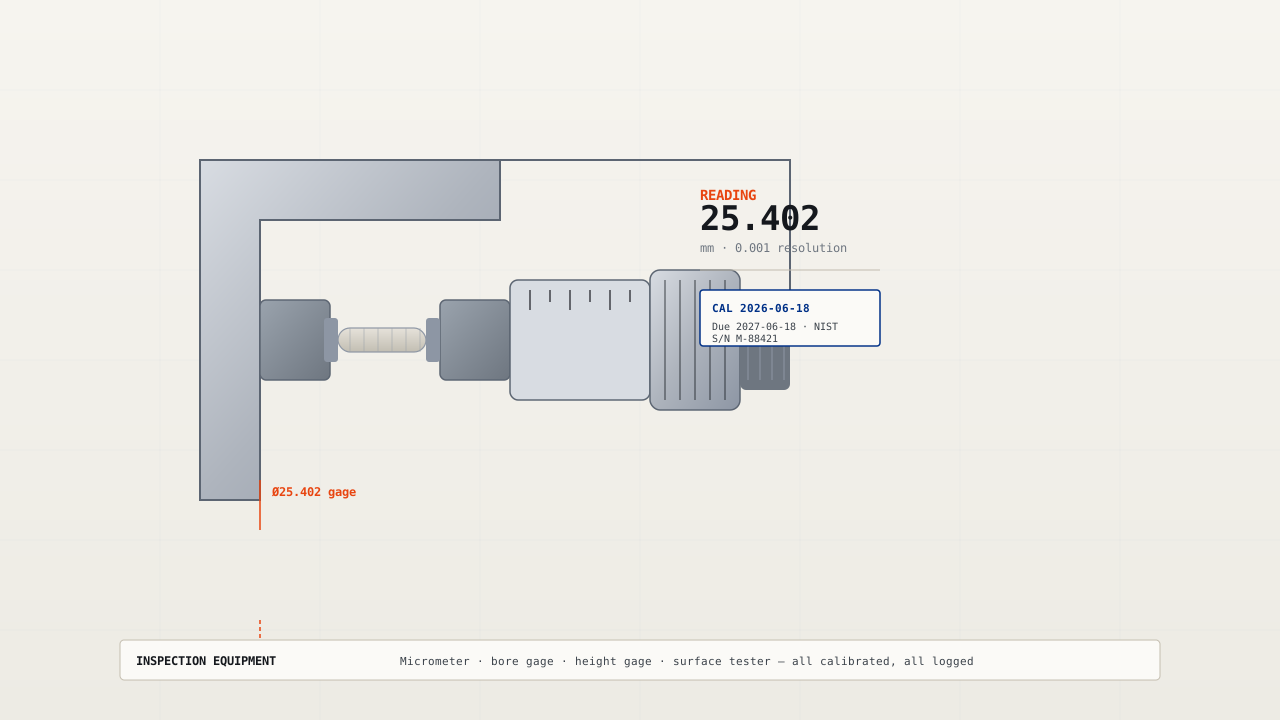
- Coordinate measuring machine (Zeiss CONTURA G2, two machines, GR&R 8.4% on the critical feature)
- Dimensional report against the drawing, with a 100% check on critical features rather than a sample
- Certificate of conformance and the mill certificate with every shipment
- Bore gauges and an optical comparator for hole position and edge form
The full equipment list, with counts, is on the capability page; the inspection sequence is on quality and inspection.
Questions buyers ask
- When does a sintered bushing beat a ball bearing?
- Low speed, oscillating motion and no maintenance access. A sintered bushing tolerates dirt and needs no oil hole, where a ball bearing in the same spot would fail from a dry race.
- Can you machine the OD after sintering?
- Yes, but keep the bore as-sintered for the oil film. Machining the bore closes the surface pores and the bushing stops self-lubricating exactly where it matters.
Related part families
Precision Ball Bearings
ABEC 5–7 deep-groove and angular contact ball bearings, runout verified on every finished race.
Precision Washers & Spacers
Flat, conical and shim washers from 0.05 mm, stamped or fine-blanked with lapped flatness.
Roller Bearings
Cylindrical, tapered and needle roller bearings for radial loads a ball bearing cannot carry.