

Miniature Bearings
Instrument bearings from Ø1 mm bore, with tight runout and low starting torque.
Small bearings for instruments and medical devices, where starting torque and runout matter more than load. Bore and runout are checked individually, not by batch sampling.
4–6 weeks
50 pieces
ISO 9001:2015
Technical Specifications
| Parameter | Value | Unit |
|---|---|---|
| Bore range | Ø1–Ø10 | mm |
| Precision class | ABEC 5–7 | - |
| Radial runout | ≤0.002 | mm |
| Starting torque | Low (measure on request) | - |
| Lubrication | Oil or grease | - |
| Inspection | 100% runout | - |
Available Materials
- Bearing steel 52100
- Stainless 440C
- Ceramic (Si3N4) balls
- Phenolic cages
Typical Applications
- Medical handpieces
- Dental turbines
- Optical instruments
- Miniature motors
- Drones
Surface Finishes
- Ground and honed
- Passivate (440C)
- Pre-lubricated (light oil)
- Shielded
- Sealed
Industries Served
- Medical
- Instrumentation
- Consumer Electronics
- Aerospace
- Robotics
What drives the price of this part
Derived from the callouts on this page. Where a driver is not on the drawing, it is not on this list.
- Part size
- Bore range at Ø1–Ø10 mm decides which machine the part lands on and how many setups it needs. Size is the driver buyers most often leave out of a first enquiry, and it is the one that changes the quote fastest.
- Material
- The first material listed, Bearing Steel 52100 (100Cr6), rates 4/10 on our machinability scale at 60–66 HRC hardened · 183–217 HB annealed. On this shop's scale a harder alloy means slower passes and more tool changes, and that is cycle time the quote has to carry.
- Order size
- Minimum order is 50 pieces, where setup and tooling are amortised across the batch and per-part cost settles around cycle time and material. Below that quantity the same part costs more per piece, not less.
See how cycle time is calculated in the machining time calculator and what else moves a price in the cost driver reference.
How these parts are inspected
Matched to the callouts above and the instruments actually on the floor.
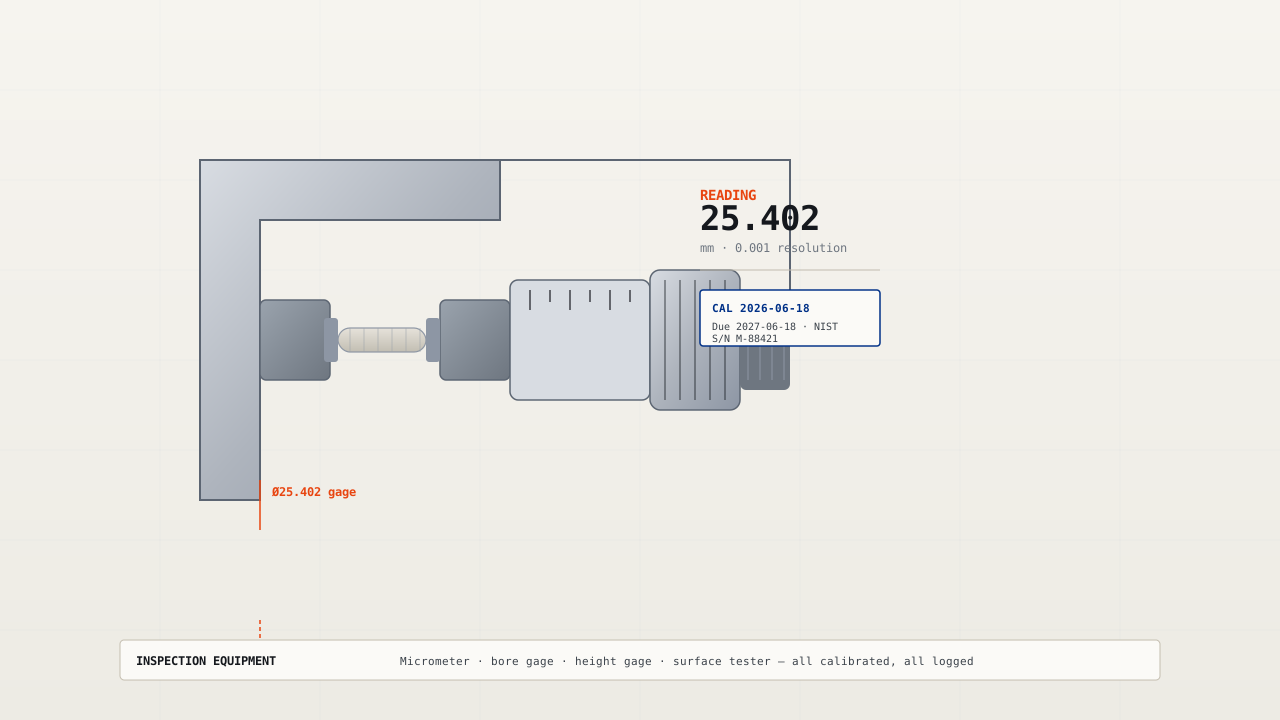
- Coordinate measuring machine (Zeiss CONTURA G2, two machines, GR&R 8.4% on the critical feature)
- Dimensional report against the drawing, with a 100% check on critical features rather than a sample
- Certificate of conformance and the mill certificate with every shipment
- Bore gauges and an optical comparator for hole position and edge form
The full equipment list, with counts, is on the capability page; the inspection sequence is on quality and inspection.
Questions buyers ask
- Why is starting torque so important at this size?
- Because a small motor has almost no torque to spare. A dry or over-greased miniature bearing will stall the drive before it ever wears out.
Related part families
Precision Ball Bearings
ABEC 5–7 deep-groove and angular contact ball bearings, runout verified on every finished race.
Sintered Bronze Bushings
Oil-impregnated bronze bushings with controlled porosity, for places you cannot re-lubricate.
Electromechanical Assemblies
Mechanical parts with connectors, harnesses and sensors fitted and function-tested before shipping.