

Precision Bored Bushings
Bushings bored and honed to size after fitting, so the bore is true in the housing.
Bushings supplied rough for fitting, or bored after pressing, so the finished bore is true to the housing rather than true to the unmounted bushing. A press fit distorts a thin wall.
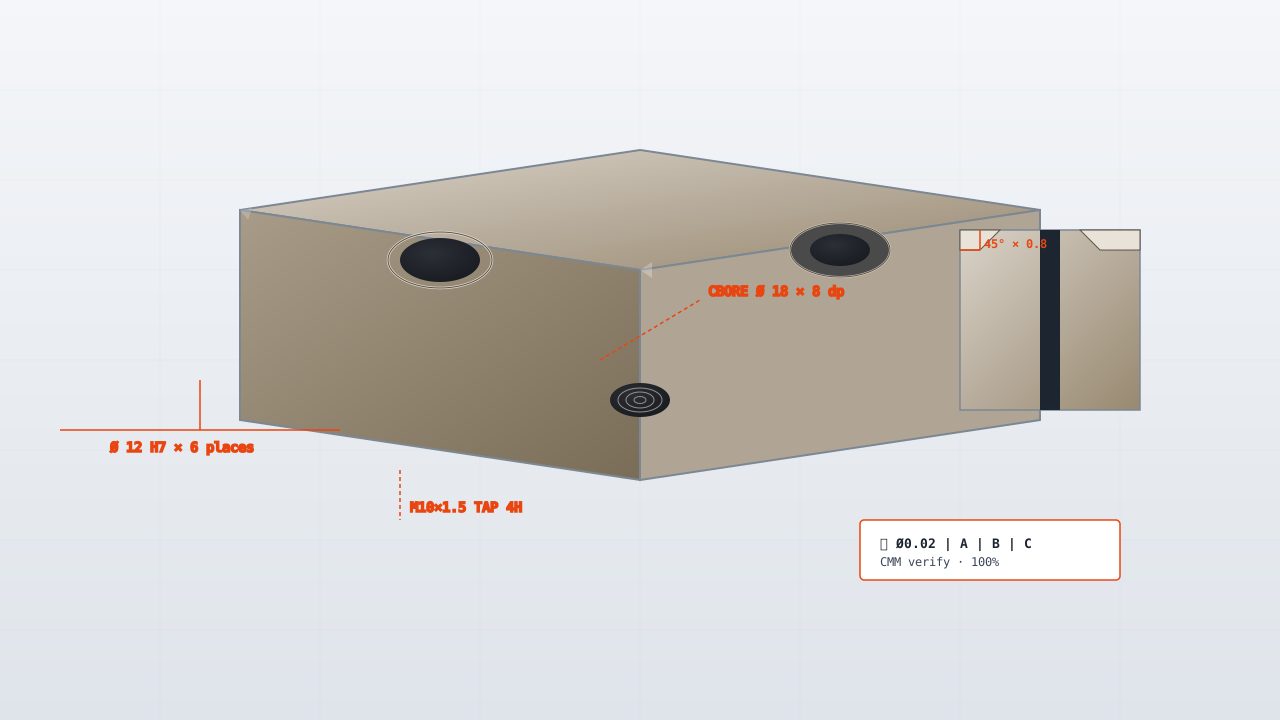
H7 (in place) -0.005 mmRa 0.4 µmØ10–Ø300 mm
Lead Time
3–5 weeks
Min Order
10 pieces
Certifications
ISO 9001:2015
Technical Specifications
| Parameter | Value | Unit |
|---|---|---|
| Bore tolerance | H7 (in place) | - |
| Bore roundness | 0.005 | mm |
| Surface roughness | Ra 0.4 | µm |
| Bore range | Ø10–Ø300 | mm |
| Oil grooves | Machined on request | - |
| Fit | Press or locked | - |
Available Materials
- Bronze C932
- Steel 4140
- Stainless 316L
- Cast iron GG25
- PTFE-lined steel
Typical Applications
- Connecting rod bushes
- Pump bearing bushes
- Machine spindle bushes
- Hinge and pivot bushes
- Marine shaft bushes
Surface Finishes
- Bored and honed in place
- Lubricated (oil grooves)
- PTFE lined
- Passivate
- Ground OD
Industries Served
- Industrial Equipment
- Marine
- Energy & Oil & Gas
- Automotive & EV
- Agricultural Machinery
What drives the price of this part
Derived from the callouts on this page. Where a driver is not on the drawing, it is not on this list.
- Tolerance
- Bore tolerance at H7 (in place) is the tightest callout this family carries. Tightening a callout is a process decision, not a machining decision: below the standard ±0.005 mm the work moves to grinding or jig boring, and the price moves with it.
- Part size
- Bore range at Ø10–Ø300 mm decides which machine the part lands on and how many setups it needs. Size is the driver buyers most often leave out of a first enquiry, and it is the one that changes the quote fastest.
- Surface finish
- Surface roughness at Ra 0.4 µm. Every step below the ordinary as-machined Ra 1.6 µm adds a finishing pass; a callout on a face nobody touches is the most common over-specification we quote.
- Material
- The first material listed, Carbon Steel 4140 (42CrMo4), rates 6/10 on our machinability scale at 197–235 HB annealed · 28–32 HRC quenched and tempered. On this shop's scale a harder alloy means slower passes and more tool changes, and that is cycle time the quote has to carry.
- Order size
- Minimum order is 10 pieces, so on a first order setup and programming are spread over very few parts and they are most of the price. Repeat orders at the same quantity are cheaper without anything on the drawing changing.
See how cycle time is calculated in the machining time calculator and what else moves a price in the cost driver reference.
How these parts are inspected
Matched to the callouts above and the instruments actually on the floor.
- Coordinate measuring machine (Zeiss CONTURA G2, two machines, GR&R 8.4% on the critical feature)
- Dimensional report against the drawing, with a 100% check on critical features rather than a sample
- Certificate of conformance and the mill certificate with every shipment
- Surface roughness tester (Mitutoyo) against the Ra callout
- Bore gauges and an optical comparator for hole position and edge form
The full equipment list, with counts, is on the capability page; the inspection sequence is on quality and inspection.
Questions buyers ask
- Why bore a bushing after fitting it?
- Because the press fit deforms it. A thin-walled bushing squeezed into a housing goes oval by the amount of the interference, and the shaft then runs on a distorted bore.
Related part families
More in Bearings & Bushings
Precision Ball BearingsSintered Bronze BushingsRoller BearingsThrust BearingsNeedle Roller BearingsLinear Bearings & ShaftsBearing HousingsAngular Contact Ball BearingsMiniature BearingsFlanged Bearings & BushingsComposite & PTFE BushingsDeep Groove Ball BearingsSelf-Aligning BearingsSlewing RingsRod Ends & Spherical BearingsPTFE-Lined BushingsStainless Steel BearingsCeramic Ball BearingsThin Section BearingsBearing Sleeves & AdaptersSplit Bushings & Half BearingsPillow Block UnitsThrust WashersBearing Liners & Sleeves