

Helical Gears
Helical gears to AGMA 9–12 with ground flanks, for quieter drives and higher tooth loads.
Helical gears cut at 15–30° helix angle for smoother mesh and more contact ratio than spur. Ground after heat treat, with helix angle and lead verified on the gear tester.
4–6 weeks
5 pieces
ISO 9001:2015 · IATF 16949
Technical Specifications
| Parameter | Value | Unit |
|---|---|---|
| Gear quality | AGMA 9–12 | class |
| Helix angle | 15–30 | ° |
| Module range | 1–8 | module |
| Pitch diameter | 20–800 | mm |
| Lead tolerance | 0.008 | mm |
| Surface finish | Ra 0.4 | µm |
Available Materials
- Steel 4140
- Steel 8620 (case hardened)
- Stainless 17-4 PH
- Bronze C932
- Nylon / POM
Typical Applications
- Reduction gearboxes
- Machine tool spindles
- Automotive transmissions
- Crane drives
- Pump drives
Surface Finishes
- Ground flanks
- Shot peened
- Case hardened
- Nitrided
- Phosphate coated
- Black oxide
Industries Served
- Automotive & EV
- Industrial Equipment
- Energy & Oil & Gas
- Rail
- Marine
What drives the price of this part
Derived from the callouts on this page. Where a driver is not on the drawing, it is not on this list.
- Tolerance
- Lead tolerance at 0.008 mm is the tightest callout this family carries. Tightening a callout is a process decision, not a machining decision: below the standard ±0.005 mm the work moves to grinding or jig boring, and the price moves with it.
- Part size
- Module range at 1–8 module decides which machine the part lands on and how many setups it needs. Size is the driver buyers most often leave out of a first enquiry, and it is the one that changes the quote fastest.
- Material
- The first material listed, Carbon Steel 4140 (42CrMo4), rates 6/10 on our machinability scale at 197–235 HB annealed · 28–32 HRC quenched and tempered. On this shop's scale a harder alloy means slower passes and more tool changes, and that is cycle time the quote has to carry.
- Order size
- Minimum order is 5 pieces, so on a first order setup and programming are spread over very few parts and they are most of the price. Repeat orders at the same quantity are cheaper without anything on the drawing changing.
See how cycle time is calculated in the machining time calculator and what else moves a price in the cost driver reference.
How these parts are inspected
Matched to the callouts above and the instruments actually on the floor.
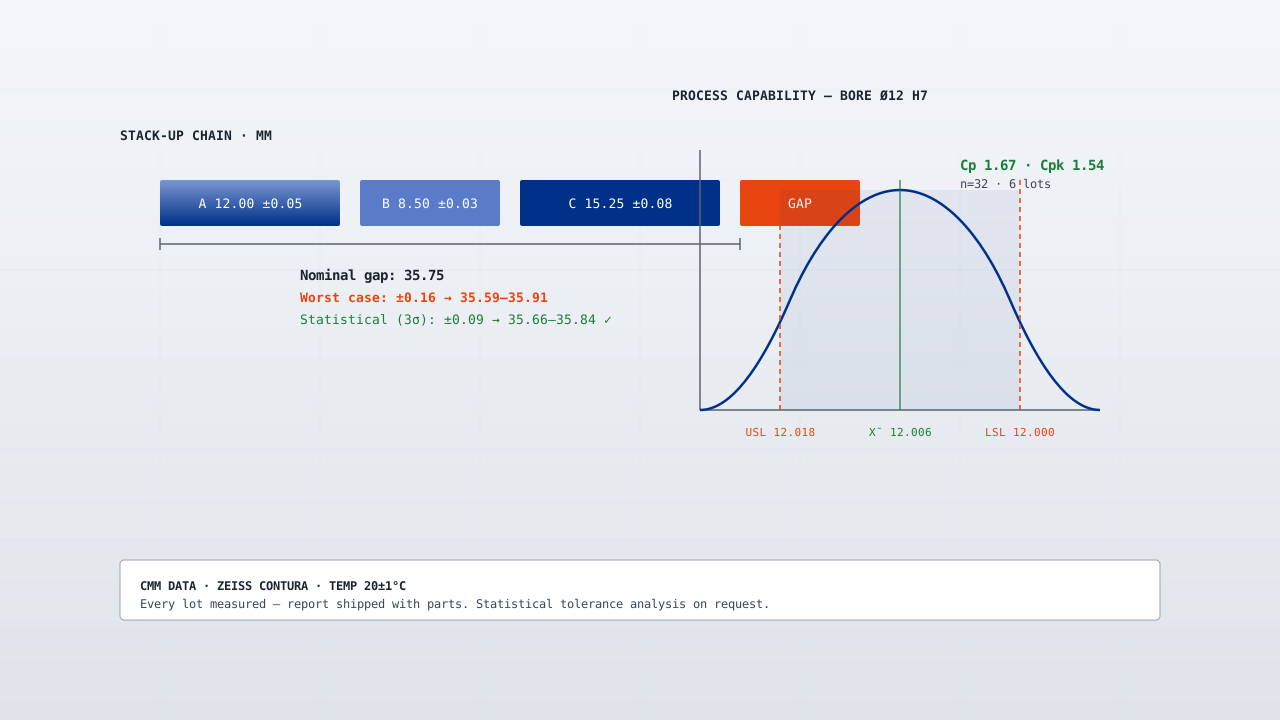
- Coordinate measuring machine (Zeiss CONTURA G2, two machines, GR&R 8.4% on the critical feature)
- Dimensional report against the drawing, with a 100% check on critical features rather than a sample
- Certificate of conformance and the mill certificate with every shipment
- First article inspection to AS9102, because this family carries an aerospace or automotive certificate
The full equipment list, with counts, is on the capability page; the inspection sequence is on quality and inspection.
Questions buyers ask
- Helical or spur for my application?
- Helical if noise or tooth load is the constraint, because the teeth engage gradually instead of all at once. Spur if the gear runs at low speed and you want to avoid the axial thrust helical puts on the bearings.
- Do you cut matched gear pairs?
- Yes, and on a matched pair we cut both from the same setup so the helix and lead error cancel. That is usually worth more than raising the class of one gear alone.
Related part families
Precision Spur Gears
AGMA 8–12 spur gears, hobbed and profile ground, from 12 mm to 800 mm pitch diameter.
Bevel & Miter Gears
Straight and spiral bevel gears for right-angle drives, lapped in pairs to a matched contact pattern.
Gear Racks
Ground and hardened gear racks in 500–3000 mm lengths, straight to 0.05 mm per metre.