

How to Read a CNC Machining Quote, Line by Line
A quote carries eight or nine line items. Most buyers read one of them. Here is what each line actually pays for, which ones I will argue about, and what a quote ought to tell you that most do not.
A quote is a model, not a price
A CNC quote is not a number with a currency symbol attached to it. It is a model of how the shop intends to make your part. When two shops come back 30 per cent apart, they are rarely disagreeing about margin. They are disagreeing about how many setups the part needs, whether the tolerance can be held on a three-axis machine or has to go on five, and whether anyone actually opened the drawing.
I read a quote backwards. I look for what is missing before I look at the total. A quote with no drawing revision, no material specification beyond the word steel, no assumptions list and no inspection line is not a cheaper quote. It is a quote with the risk left out, and risk does not disappear. It comes back later as a rework, or a re-quote, or a part that will not assemble on your line.
The lines behind the number
Shops lay their quotes out differently. Underneath, the same eight or nine things are being paid for. Here is what each one means, and what is worth asking about before you sign anything.
Material. The question is not which alloy. It is what shape the shop is buying and how much of it you are paying for. A quote built on an oversized plate buys you chips. Ask what stock size the price assumes, and whether the mill certificate is included or billed separately. On titanium and Inconel the material line can rival the machining line, so this is the first place a quote becomes negotiable.
Setup, sometimes labelled NRE or programming. This pays for CAM programming, the fixture and the first article. It is a one-time charge per job, which is worth confirming in writing. If you will reorder the part, ask whether the fixture is kept and whether a repeat is charged setup again. A shop that recharges full setup on a part it has already made is telling you something about how it treats repeat customers.
Cycle time. Ask which machine the part is quoted on. A simple bracket on a three-axis Haas at roughly 75 dollars an hour and the same bracket on a DMG MORI DMU 80 at roughly 150 dollars an hour are two different quotes for one drawing. Five-axis is worth the rate when it removes a setup. It is not worth the rate when the part would have gone in one three-axis fixture.
Tooling. Standard cutters are consumed, not charged. A form tool, a custom thread mill or an insert ground to your profile is a real one-off cost, and it is legitimate. Ask what it is, what it costs and who keeps it after the job.
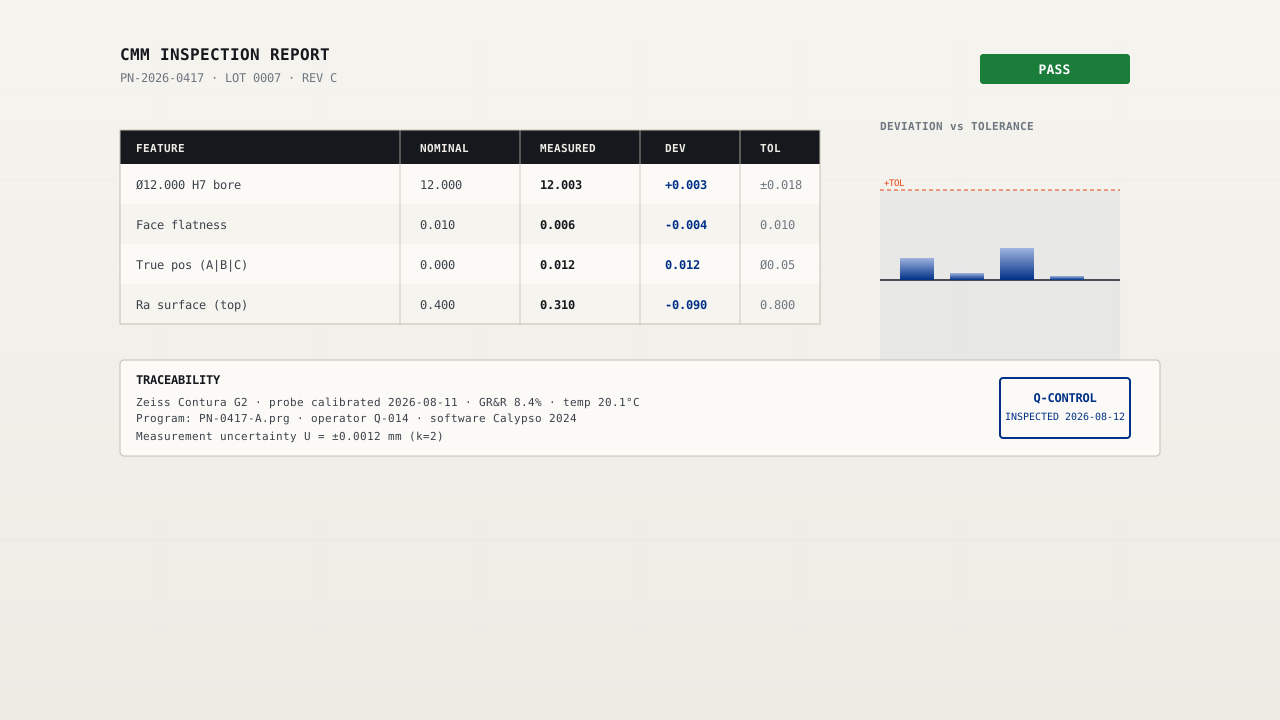
Inspection. Tight tolerances are slower to prove than to cut. A position tolerance on a hole pattern, or a 0.005 mm callout on a 200 mm part, means a CMM program, a datum alignment and a report. That is metrologist time. Confirm whether the CMM report is inside the price and whether it covers the first article or every part.
Outside processes. Anodising has a batch minimum. Plating has a lot charge. Heat treatment has a furnace minimum. On a run of ten parts, one of those is often the largest single line on the quote, larger than the machining, and buyers miss it because it is listed last. Ask for the outside-process charges broken out so you can see them.
Freight and packaging. Rarely worth your negotiating energy, unless the parts are heavy or the finish is soft. Spend the effort on tolerance instead.
Margin. Every shop has one. A quote with no visible margin is a quote with a hidden assumption somewhere else in the document.
Why one piece costs what it does
The mathematics of a one-off is not a mystery and it is not an attitude problem. Take a bracket with a 12 minute cycle. Add 90 minutes of programming, 45 minutes to make a fixture and 30 minutes for the first article. That is 165 minutes of work that happens once, before the first good part comes off the machine.
At a hundred pieces those 165 minutes are divided a hundred ways and they vanish into the unit price. At one piece you pay all of it. Then add the material minimum, because nobody will sell you 120 mm of titanium bar, and the single-piece price lands four or five times the fifty-piece price.
The most common email we get is some version of: why is one piece 340 dollars when fifty is 38? That is the answer. It is arithmetic.
The lines I will argue about, and the ones I will not
There is a category of quote line where a shop should push back hard, and buyers are often surprised by which one it is.
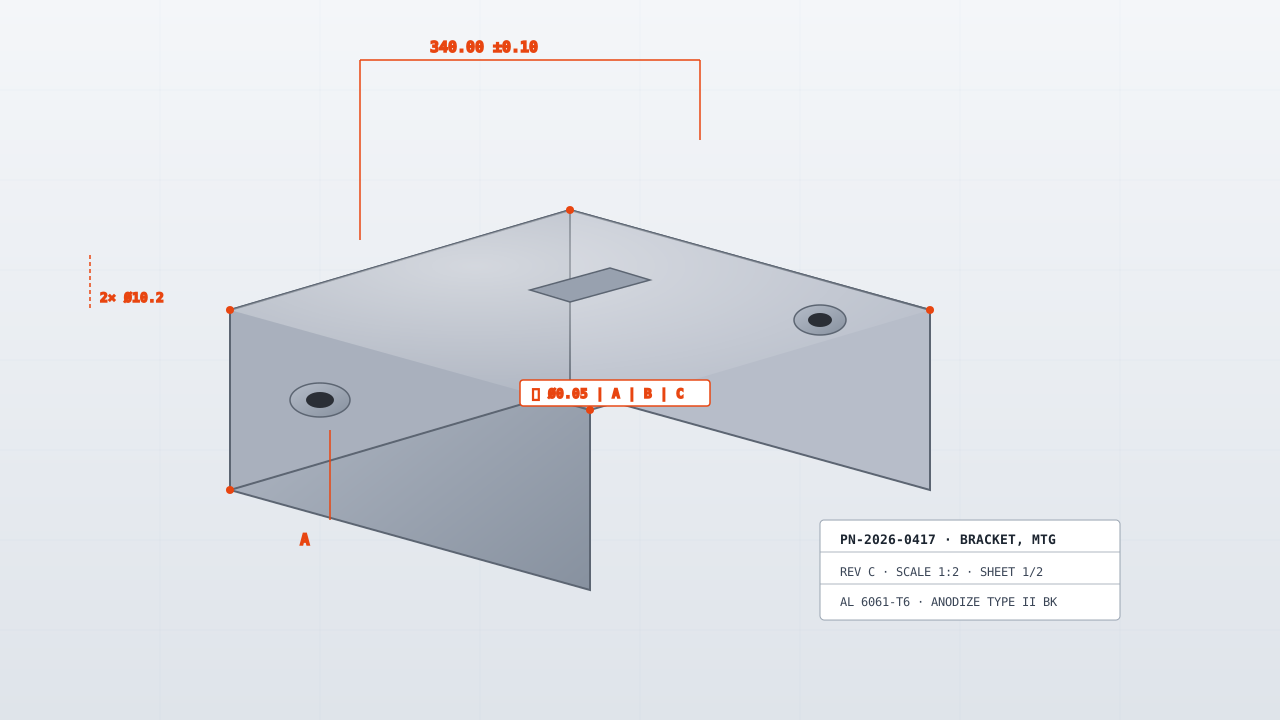
I will argue with you about tolerances on faces that mate with nothing, surface finish on a bracket that lives inside a cabinet, corner radii smaller than the cutter that has to cut them, and whether every part in a run needs a CMM report or only the first one. Those are cost without function. Removing them is close to free quality, and any shop that has looked at your part can point them out in ten minutes.
I will not move on the material grade, the certification package on a regulated part, or the inspection level a safety-critical feature needs. If a quote comes back cheaper because someone quietly reduced your material specification or dropped the CMM report, that is not a better quote. That is the risk moving off the shop's books and onto yours.
What a quote should tell you, and usually does not
There are nine things that belong on a machining quote: the drawing revision and part number, the material specification and stock form, the quantity breakpoints, the process route, what the price includes, what it excludes, the lead time and what that lead time starts from, how long the quote is valid, and the assumptions.
The assumptions list is the one that separates a working shop from a broker. It is where a shop writes down what it had to guess. That the bore is a clearance hole, not a press fit. That the deburr note means a light radius. That the material certificate is mill traceability, not a mechanical test report. Those lines cost nothing to write and they prevent the argument that would otherwise happen three weeks later.
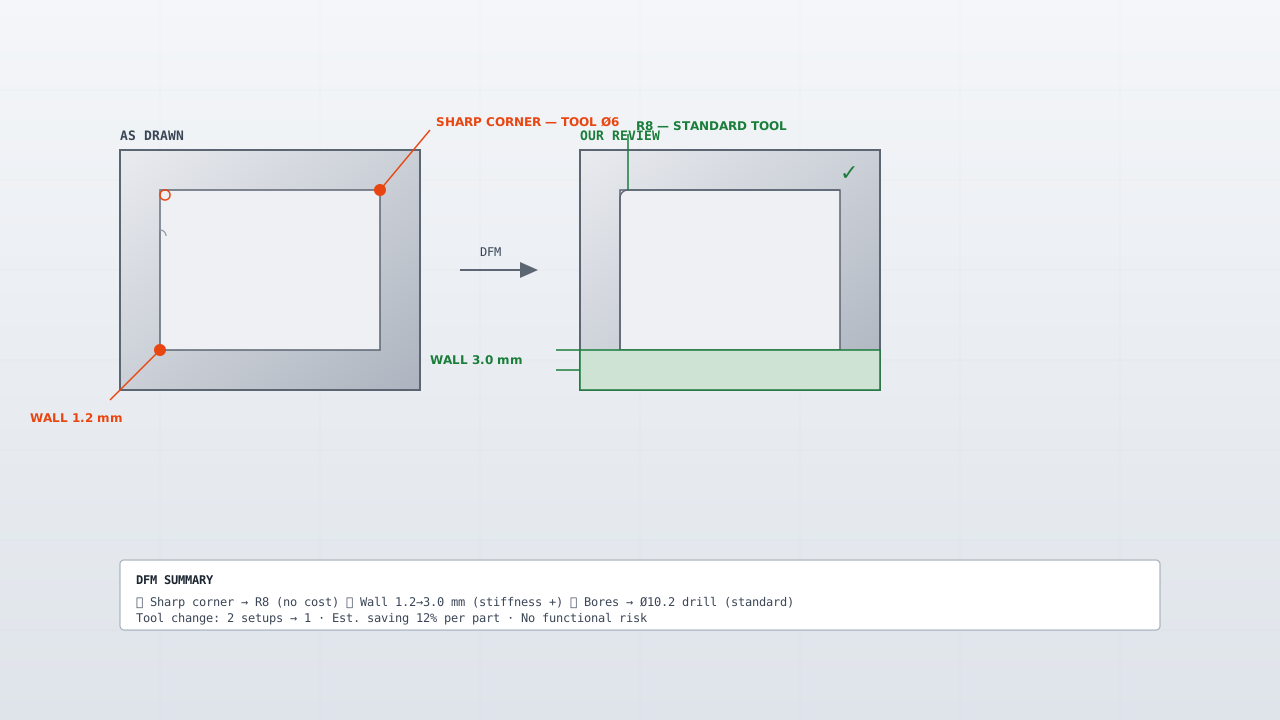
The DFM note is the other indicator. If the quote comes with two lines explaining that moving a corner radius from 1 mm to 3 mm would take twenty minutes off the cycle, someone opened your model and thought about it. If the quote is a number and a lead time, nobody did.
Six things that make me look twice
This is not a list of sins. These are the things that, when a customer shows me a competitor's quote, make me ask a question before they place the order.
No drawing revision on the quote. It means the price may be against an older revision than the one you are sending to everybody else.
A lead time quoted with no mention of material. On most jobs the stock is the long item, not the machine queue. A date given before the material is checked is a guess wearing a date format.
A five-axis price for work that is plainly three-axis. Usually it means the part was never looked at and the number is a placeholder.
An as machined finish on a part that has a sealing face or a bearing seat. Either the drawing was not read, or the finish requirement was quietly assumed away.
Certifications mentioned only after you ask. A quality system that is real tends to appear on the quote without prompting.
A price 40 per cent under everyone else with no explanation attached. Sometimes that is a shop with capacity and it is a genuine bargain. More often it is a quote resting on an assumption nobody wrote down, and you will meet that assumption at first article.
Comparing two quotes without being fooled
Two quotes are only comparable when the scope is identical: same drawing revision, same quantity, same material specification, same finish, same documentation. Change any one of those and you are comparing two different jobs, whatever the totals suggest.
Then add the costs that are not printed on the page. A quote that comes in 15 per cent cheaper and needs one rework cycle has cost more than the one you rejected. Rework is not just a second machining operation. It is the week of schedule, the expedited freight, and the assembly line that was waiting. That is why we ask for the drawing revision before we quote and not after.
Ask both shops to put their exclusions in writing. The shop that can list what it is not covering is the shop that knows what it is covering.
Straight answers
The questions that come up most often when a buyer has a quote in hand.
What is NRE on a machining quote? Non-recurring engineering. It covers the work that happens once: CAM programming, fixture design and build, and the first article. It is charged once per job, not per part. On a repeat order it should drop sharply or disappear, unless the shop is building a new fixture or has changed the process.
Why is the setup fee listed separately from the part price? Because it is a one-time cost and separating it makes the quantity effect visible. Folded silently into the unit price, the fifty-piece and one-piece prices would look less different than they actually are, and you would have no way to see what a repeat order should cost.
Why is one part so much more expensive than fifty? Programming, fixturing and first-article inspection are one-time. At quantity one you buy all of them. At fifty they are divided fifty ways. Material minimums make it worse, because a small part still forces a full bar or plate purchase.
What does as machined mean on a quote? It means the surface is left as the cutting process produced it, with a defined edge break and no added finishing. On most parts that is Ra 3.2 to 1.6 micrometres. It is not acceptable on a sealing face, a bearing seat or a sliding surface, where the drawing should carry its own finish callout.
How do I compare two CNC quotes fairly? Pin the scope first: drawing revision, quantity, material specification, finish, documentation. Then make both shops list their exclusions and assumptions in writing. A quote without that list is not comparable. It is just shorter.
Have a quote in front of you that does not add up?
Send the drawing and the quote. We will tell you what the other shop assumed, what we would assume, and where the difference in the number comes from. No algorithm, an engineer reading the print.
Related reading: how to choose a CNC machining partner, what tolerances are achievable and what they cost, what actually moves a lead time, and incoterms for parts buyers.